A type 2 diabetes diagnosis changes how you think about food, physical activity, weight, and the medications that may become part of your daily routine. The question most patients ask first is direct: what is the treatment for type 2 diabetes, and what does that mean for me specifically?
The honest answer is that treatment for type 2 diabetes is not one thing. Managing type 2 diabetes involves a combination of strategies — lifestyle changes that directly improve how the body handles blood sugar, diabetes medication that works through specific biological mechanisms to lower glucose levels, and regular clinical monitoring to assess whether the current plan is working. For some patients with newly diagnosed type 2 diabetes, lifestyle changes alone can bring blood sugar into target ranges. For many others, diabetes medication is necessary from the start or becomes necessary over time.
This guide covers every major treatment option for type 2 diabetes: what each does, how it works, and how physicians at Core Primary Care use these tools to build individualized treatment plans for patients across Houston, Sugar Land, Katy, and Needville, TX. All clinical information reflects current guidance from the American Diabetes Association, the CDC, the NHS, and peer-reviewed evidence.
Understanding the Goal of Type 2 Diabetes Treatment
Before choosing a treatment, it helps to understand what treating type 2 diabetes means clinically. The primary goal is not simply to lower blood sugar in isolation — it is to maintain blood glucose levels within ranges that prevent or slow the development of diabetes complications: damage to the kidneys, eyes, nerves, heart, and circulatory system that accumulates when blood sugar remains elevated over years.
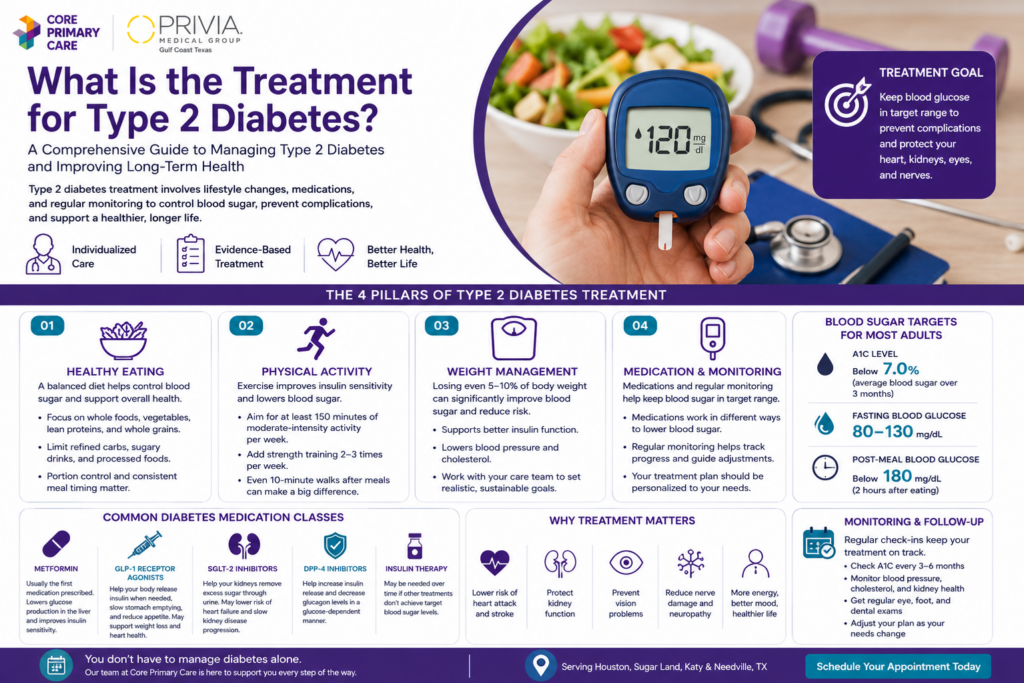
The American Diabetes Association defines target ranges for most adults with type 2 diabetes as:
- A1C level below 7.0% (a measure of average blood sugar level over three months)
- Fasting blood glucose: 80–130 mg/dL
- Post-meal blood glucose: below 180 mg/dL two hours after eating
Some patients — particularly older adults or those with significant comorbidities — have individualized targets set by their physician that differ from these general guidelines. Reaching and maintaining these targets is what all treatment options for type 2 diabetes are designed to achieve.
A secondary goal of modern diabetes treatment is cardiovascular and kidney protection. Several newer diabetes medications — particularly GLP-1 receptor agonists and SGLT-2 inhibitors — have demonstrated in large cardiovascular outcomes trials that they reduce the risk of heart attack, stroke, and kidney disease progression in patients with type 2 diabetes who have established cardiovascular disease or high cardiovascular risk. This evidence has shifted how physicians approach medication selection beyond glucose control alone.
Lifestyle Changes as a Foundation for Type 2 Diabetes Treatment
Lifestyle changes are not a soft alternative to diabetes treatment — they are a clinically effective first-line intervention that the American Diabetes Association recommends for every patient with type 2 diabetes, with or without medication. Managing type 2 diabetes involves these changes even when medication is also prescribed, because lifestyle factors directly affect how well blood glucose control is achieved.
Dietary Modification
No single diet has been proven universally superior for people with type 2 diabetes, but the dietary patterns with the strongest clinical evidence for improving blood sugar level and reducing cardiovascular risk include:
Low-carbohydrate diets: Carbohydrates are the primary dietary factor that raises blood sugar after meals. Reducing refined carbohydrates — white bread, pasta, white potatoes, sugar-sweetened drinks — produces the most direct reduction in post-meal blood glucose spikes. Multiple randomized controlled trials support low-carbohydrate eating patterns for short- to medium-term A1C improvement.
Mediterranean-style eating: Emphasizing vegetables, legumes, fish, olive oil, whole grains, and limited processed food, the Mediterranean diet has strong evidence from trials including PREDIMED for improving A1C level, blood pressure, and cardiovascular risk in patients with type 2 diabetes. It is the dietary pattern most consistently recommended by both diabetes and cardiovascular guidelines simultaneously.
Reduced-calorie eating for weight management: Because insulin resistance — the core mechanism driving type 2 diabetes — is strongly tied to excess body weight (particularly abdominal fat), caloric reduction that produces sustained weight loss has a direct therapeutic effect on blood glucose levels and diabetes outcomes. A 5–10% reduction in body weight produces measurable A1C improvements for most individuals.
Physical Activity
Exercise is a direct treatment for type 2 diabetes, not just a health recommendation. Muscle tissue takes up glucose during physical activity independently of insulin — meaning aerobic exercise lowers blood glucose immediately and improves insulin sensitivity for 24–72 hours afterward.
The American Diabetes Association recommends at least 150 minutes per week of moderate-intensity aerobic activity — spread across at least three days — as the minimum evidence-based amount for meaningful blood glucose management. Adding resistance training two to three times per week produces greater improvements in A1C level and blood glucose levels than aerobic activity alone.
For patients newly diagnosed with type 2 diabetes who are not currently active, starting with 10-minute post-meal walks is a clinically supported entry point that produces measurable reductions in post-meal blood sugar without requiring immediate commitment to long workout sessions.
Weight Loss
Of all lifestyle factors, significant weight loss has the largest and most consistently documented effect on blood sugar in type 2 diabetes. Excess adipose tissue — particularly visceral fat — releases inflammatory signals that impair the body’s ability to use insulin effectively, driving insulin resistance. Reducing it directly improves insulin sensitivity, lowers fasting blood glucose, and in recently diagnosed patients who achieve significant weight loss, can produce type 2 diabetes remission.
The landmark DiRECT trial demonstrated that nearly 50% of participants who lost 10–15 kg (22–33 lbs) achieved diabetes remission within one year. For patients diagnosed with type 2 diabetes who are carrying excess weight, physician-supervised weight loss programs — including GLP-1 medications where appropriate — address both diabetes and obesity simultaneously.
Stress Management and Sleep
Cortisol — the hormone the body releases under chronic stress — directly raises blood sugar by stimulating glucose release from the liver. Poor sleep independently worsens fasting blood glucose and increases insulin resistance. Both factors undermine blood glucose control even when dietary and exercise habits are consistent. Diabetes management that ignores stress and sleep quality is incomplete.
Medications for Type 2 Diabetes — The Complete Overview
When lifestyle changes alone are insufficient to bring blood sugar within target ranges — or when the A1C level at diagnosis is high enough that medication is clinically appropriate from the start — diabetes medication becomes part of the treatment plan. Several distinct drug classes are used to treat type 2 diabetes, each working through different mechanisms with different evidence profiles.
| Medication Class | How It Lowers Blood Sugar | Key Benefit |
| Metformin | Reduces liver glucose production; improves insulin sensitivity | First-line; low cost; weight-neutral |
| GLP-1 Receptor Agonists | Stimulates insulin release; slows digestion; reduces appetite | Weight loss + cardiovascular protection |
| SGLT-2 Inhibitors | Causes kidneys to excrete excess glucose in urine | Weight loss + kidney and heart protection |
| DPP-4 Inhibitors | Extends natural GLP-1 action after meals | Well tolerated; weight-neutral |
| Sulfonylureas | Stimulates pancreas to produce more insulin | Inexpensive; strong glucose lowering |
| Thiazolidinediones | Improves insulin sensitivity in muscle and fat | Some cardiovascular evidence (pioglitazone) |
| Insulin | Directly replaces or supplements endogenous insulin | Most flexible; required when beta cells fail |
Metformin — The Standard First-Line Medication
Metformin is the most prescribed medication for type 2 diabetes and has been the recommended first-line diabetes medicine for most newly diagnosed patients for decades. It works primarily by reducing the amount of glucose the liver produces and releases into the bloodstream between meals, and by improving how cells respond to insulin.
Metformin is inexpensive, has a long safety track record, causes modest weight loss or weight neutrality in most patients, and does not cause low blood sugar when used alone. The UK Prospective Diabetes Study — one of the largest and longest clinical trials of diabetes treatment — established metformin’s evidence base for reducing diabetes complications and cardiovascular events in adults with type 2 diabetes.
Common side effects of metformin are primarily gastrointestinal — nausea, diarrhea, and stomach upset — and typically diminish over the first few weeks. Starting with a low dose and taking it with food reduces these effects. Extended-release formulations are better tolerated by patients sensitive to the immediate-release version.
GLP-1 Receptor Agonists — Semaglutide, Tirzepatide, and Others
Glucagon-like peptide-1 (GLP-1) receptor agonists are injectable medications for type 2 diabetes that work by mimicking GLP-1, a hormone naturally released by the gut after eating. They stimulate the pancreas to make more insulin in response to meals, slow gastric emptying (reducing post-meal glucose spikes), suppress appetite, and reduce glucagon secretion.
Medications in this class include semaglutide (Ozempic, Wegovy), tirzepatide (Mounjaro, Zepbound — a dual GLP-1 and GIP agonist), liraglutide (Victoza), and dulaglutide (Trulicity). They are among the most effective options for lowering A1C level and producing meaningful weight loss simultaneously — making them particularly relevant for patients where diabetes and obesity intersect.
Several GLP-1 receptor agonists have demonstrated cardiovascular outcomes benefits in major trials — reducing risk of heart attack, stroke, and cardiovascular death in patients with type 2 diabetes who have established cardiovascular disease. This evidence has elevated GLP-1 medications from glucose-lowering drugs to cardiovascular risk reduction agents in appropriate patients.
Common side effects include nausea, vomiting, and reduced appetite, which are most pronounced during dose escalation and typically improve over time. Semaglutide and tirzepatide are once-weekly injections; other agents in the class may be once-daily or twice-daily.
SGLT-2 Inhibitors — Empagliflozin, Dapagliflozin, Canagliflozin
Sodium-glucose cotransporter-2 (SGLT-2) inhibitors work by causing the kidneys to excrete excess glucose through urine rather than reabsorbing it back into the bloodstream. They lower blood glucose independently of insulin — meaning they work even in patients whose insulin-producing beta cells have declined — and produce modest weight loss as a result of caloric glucose loss.
The three most widely used SGLT-2 inhibitors are empagliflozin (Jardiance), dapagliflozin (Farxiga), and canagliflozin (Invokana). Like GLP-1 receptor agonists, these medications have demonstrated cardiovascular and kidney-protective benefits in large outcome trials — particularly for patients with type 2 diabetes who have chronic kidney disease or heart failure. This makes them a preferred add-on medication for patients with those conditions.
Common side effects include increased urination frequency, genital yeast infections (due to higher glucose concentration in urine), and a rare but serious complication called diabetic ketoacidosis. They are generally not used in patients with significantly reduced kidney function.
DPP-4 Inhibitors — Sitagliptin and Others
Dipeptidyl peptidase-4 (DPP-4) inhibitors work by blocking the enzyme that breaks down naturally occurring GLP-1, thereby increasing its concentration and extending its glucose-lowering effects after meals. They are taken orally, are weight-neutral, and do not cause low blood sugar when used without insulin or sulfonylureas.
Medications in this class include sitagliptin (Januvia), saxagliptin (Onglyza), and linagliptin (Tradjenta). They are modestly effective at lowering A1C and are well tolerated, making them a useful option for patients who cannot tolerate metformin or who need add-on treatment with low side-effect burden. Common side effects include upper respiratory tract infections and, less commonly, joint pain.
Sulfonylureas — Glipizide, Glimepiride, and Others
Sulfonylureas are an older class of oral diabetes medication that work by stimulating the pancreas to produce more insulin regardless of blood glucose level. They are inexpensive and effective at lowering blood sugar, but carry two significant limitations: they can cause low blood sugar (hypoglycemia) because they stimulate insulin release whether or not blood glucose is actually elevated, and they are associated with modest weight gain.
Medications in this class include glipizide, glimepiride, and glyburide. Using insulin or sulfonylureas together requires patients to check blood sugar levels more frequently and carry fast-acting glucose in case of low blood sugar episodes. Despite their limitations, they remain widely used due to their low cost and established efficacy.
Thiazolidinediones — Pioglitazone
Thiazolidinediones improve insulin sensitivity in muscle and fat tissue by activating receptors that regulate glucose and fat metabolism. Pioglitazone (Actos) is the primary agent used clinically after rosiglitazone was restricted due to cardiovascular concerns. Pioglitazone is effective at lowering blood sugar and has evidence for reducing cardiovascular events in some patients, but is associated with weight gain, fluid retention, and an increased risk of bone fractures with long-term use.
Meglitinides — Repaglinide and Nateglinide
Meglitinides stimulate short-acting insulin release from the pancreas in response to meals. Repaglinide and nateglinide are taken before each meal and are useful for patients with irregular eating schedules who need flexible dosing. They carry a risk of low blood sugar and are less commonly prescribed than other medication classes due to their more frequent dosing requirement.
Insulin Therapy for Type 2 Diabetes
Insulin is a hormone produced by the pancreas that allows cells to take up glucose from the bloodstream. In type 2 diabetes, the pancreas initially produces sufficient insulin but cells are resistant to its effects. Over time, beta cell function often declines, and the pancreas can no longer produce enough insulin to compensate. At this stage, patients with type 2 diabetes may need to take insulin to maintain blood glucose control.
Starting insulin does not mean the treatment plan has failed — it reflects the natural progression of a chronic condition in which beta cell capacity declines over time regardless of how well lifestyle and medication management has been maintained. Types of insulin include long-acting (basal) formulations that provide background glucose control through the day and night, and short-acting (bolus) formulations taken with meals to cover post-meal blood glucose rises.
Patients who take insulin need to check blood sugar levels regularly — or use a continuous glucose monitor (CGM) — to adjust doses appropriately and recognize signs of low blood sugar. Insulin doses are adjusted based on A1C levels, fasting blood glucose patterns, and post-meal readings.
How Physicians Build a Type 2 Diabetes Treatment Plan
Managing type 2 diabetes involves matching treatment options to individual patient characteristics — not applying a universal protocol. The factors physicians weigh when developing a treatment plan include:
- A1C level at diagnosis: Patients with A1C below 8% may be appropriate for a lifestyle-first approach. Those with A1C above 9–10% at diagnosis typically require medication from the start to bring blood glucose into a safer range quickly.
- Cardiovascular and kidney status: Patients with established cardiovascular disease or chronic kidney disease are prioritized for GLP-1 receptor agonists or SGLT-2 inhibitors, which have specific organ-protective evidence.
- Weight: For patients where diabetes and obesity overlap, GLP-1 receptor agonists or tirzepatide offer simultaneous blood glucose and weight management benefits that other medication classes do not.
- Newly diagnosed type 2 diabetes: Patients recently diagnosed who have not had significantly elevated blood sugar for extended periods are the best candidates for lifestyle-first approaches — including the possibility of type 2 diabetes remission through significant weight loss.
- Tolerability and practical factors: A treatment plan the patient cannot or will not follow produces worse outcomes than a less aggressive plan they can maintain consistently. Cost, injection discomfort, dosing frequency, and side effect profile all affect adherence.
Regular diabetes management — including A1C testing every three to six months, kidney function monitoring, blood pressure management, high blood pressure screening, and annual dilated eye exams — is part of how physicians prevent complications in patients with type 2 diabetes over the long term.
Combination Therapy — How Treatment Evolves Over Time
Type 2 diabetes is a progressive condition for most patients. The UK Prospective Diabetes Study established that even with excellent initial management, most adults with type 2 diabetes require intensification of their treatment plan over years as beta cell function gradually declines.
This is not a treatment failure — it is the natural history of the disease. The appropriate response is stepwise therapy intensification: adding a second or third medication class to the existing plan, or transitioning to injectable therapy when oral medications are no longer sufficient to maintain target blood glucose levels.
For patients with newly diagnosed type 2 diabetes who achieve significant weight loss and lifestyle change, the trajectory can run in the other direction — reducing medication doses or achieving remission. This is the goal of structured lifestyle intervention programs and physician-supervised weight loss alongside diabetes management.
Monitoring Your Blood Sugar During Treatment
Checking blood sugar levels is a core part of managing type 2 diabetes — it shows whether the treatment plan is working, which foods spike blood glucose, and whether adjustments are needed. There are two primary monitoring tools:
Standard Blood Glucose Meter
A finger-stick device that measures current blood glucose level. Used to check fasting blood glucose in the morning, post-meal readings, and blood sugar before and after exercise. Patients using insulin or sulfonylureas need to check blood sugar regularly to detect low blood sugar episodes.
Continuous Glucose Monitor (CGM)
A sensor worn on the body that measures blood glucose continuously throughout the day, showing patterns and trends that individual readings miss. CGM use has expanded significantly among patients with type 2 diabetes because it provides a real-time picture of how food, exercise, stress, and medication interact with blood glucose levels.
A1C level testing at the physician’s office — typically every three to six months — provides the measure of average blood sugar over the preceding 90 days. It is the primary indicator of how well the overall treatment plan is controlling blood glucose, and the key metric used to determine whether treatment changes are needed.
| Measurement | ADA Target | Concern Threshold | Notes |
| Fasting glucose | 80–130 mg/dL | Above 130 mg/dL | Morning, before eating |
| Post-meal (2 hrs) | Below 180 mg/dL | Above 180 mg/dL | 2 hours after first bite |
| A1C level | Below 7.0% | Above 8.0% (high risk) | 3-month average blood sugar |
When to See a Physician for Type 2 Diabetes Treatment
Physician evaluation is the appropriate starting point and ongoing anchor for diabetes care. Specific situations that require prompt attention include:
- You have been diagnosed with type 2 diabetes and need a treatment plan developed — or want to understand whether lifestyle changes alone are appropriate for your situation
- You are already managing with lifestyle or medication and want to verify your A1C level and blood glucose levels are within target ranges
- You are experiencing symptoms of high blood sugar: excessive thirst, frequent urination, blurred vision, unexplained fatigue, or slow-healing wounds
- Your blood glucose control has worsened on your current medication, which may indicate disease progression or a need for treatment plan adjustment
- You have a family history of diabetes, prior gestational diabetes, or prediabetes and type 2 diabetes risk, and want to prevent or delay diabetes onset through structured intervention
Core Primary Care provides physician-supervised diabetes management across all four Greater Houston locations. Our clinical team assesses your A1C level, blood glucose patterns, cardiovascular risk, weight, and health history to develop an individualized treatment plan — whether that means lifestyle-first management, medication, or a combination of both.
Frequently Asked Questions About Type 2 Diabetes Treatment
What is the first-line treatment for type 2 diabetes?
The American Diabetes Association recommends that most adults with newly diagnosed type 2 diabetes begin a combination of lifestyle changes — diet modification, physical activity, and weight management — alongside metformin, the standard first-line medication for type 2 diabetes. For patients with very high A1C levels at diagnosis (above 10%), or with established cardiovascular disease, more aggressive initial therapy or combination medication may be appropriate from the start.
How is type 2 diabetes treated when metformin is not enough?
When blood glucose levels remain above target despite metformin and lifestyle changes, a second medication is added. The choice depends on individual patient characteristics: GLP-1 receptor agonists or SGLT-2 inhibitors are preferred for patients with cardiovascular disease or kidney disease; GLP-1 agents are preferred when significant weight loss is also a goal; DPP-4 inhibitors are an option when tolerability is the primary concern. Many patients with type 2 diabetes eventually use two or three diabetes medications in combination.
What are the injectable medications for type 2 diabetes?
Injectable medications for type 2 include GLP-1 receptor agonists (semaglutide, liraglutide, tirzepatide, dulaglutide) and insulin. GLP-1 medications are typically weekly or daily injections that lower blood glucose and produce weight loss. Insulin — either long-acting basal insulin or short-acting mealtime insulin — is used when the pancreas can no longer produce sufficient insulin to maintain blood glucose control. Injectable medications are not a last resort; GLP-1 receptor agonists are now often started early in the treatment plan due to their combined blood sugar and cardiovascular benefits.
Can type 2 diabetes be treated without medication?
For some patients — particularly those recently diagnosed with type 2 diabetes who achieve significant weight loss and commit to structured lifestyle changes — managing blood glucose within target ranges without medication is achievable. Clinical evidence from the DiRECT trial confirms that approximately 30–50% of patients who lose 10–15% of body weight within the first year can achieve type 2 diabetes remission. This is not achievable for all patients, and physician assessment is required to determine appropriateness. See our related guide: How to Manage Type 2 Diabetes Without Medication for full clinical detail.
What is the difference in treatment between type 1 and type 2 diabetes?
Type 1 diabetes is an autoimmune condition in which the pancreas produces no insulin; people with type 1 diabetes must take insulin to survive, and no lifestyle intervention changes this. Type 2 diabetes involves insulin resistance and relative insulin insufficiency rather than absent insulin production — meaning lifestyle changes and oral medications are effective treatment tools in the way they are not for type 1 diabetes. The two conditions share a name and some complications but require fundamentally different treatment approaches.
How do GLP-1 receptor agonists treat type 2 diabetes?
GLP-1 receptor agonists mimic the action of glucagon-like peptide-1, a hormone naturally secreted by the gut after meals. They stimulate the pancreas to release insulin in proportion to blood glucose level, suppress glucagon (which raises blood glucose), slow digestion to reduce post-meal blood glucose spikes, and reduce appetite. Several agents in this class have demonstrated cardiovascular risk reduction in outcome trials, making them relevant for patients managing both diabetes and cardiovascular disease risk.
What happens if type 2 diabetes goes untreated?
Untreated or poorly controlled type 2 diabetes produces progressive damage to blood vessels and nerves throughout the body. Diabetes complications include diabetic kidney disease, diabetic retinopathy (vision damage), peripheral neuropathy (nerve damage in the feet and legs), and significantly elevated cardiovascular risk. Consistent diabetes care — lifestyle changes, medication where indicated, regular monitoring, and A1C level management — is what prevents or delays these outcomes. This is why diabetes management is an ongoing medical relationship, not a one-time intervention.
Key Takeaways
- Treatment for type 2 diabetes is individualized and typically combines lifestyle changes with one or more diabetes medications
- Metformin remains the standard first-line diabetes medicine for most newly diagnosed type 2 diabetes patients
- GLP-1 receptor agonists and SGLT-2 inhibitors have cardiovascular and kidney-protective evidence that extends beyond blood sugar control
- Injectable medications for type 2 diabetes — including GLP-1 agents and insulin — are effective treatment tools, not last resorts
- A1C level is the primary clinical measure of diabetes management success; target is below 7.0% for most adults
- Type 2 diabetes is progressive; most patients require treatment intensification over time — this reflects disease biology, not treatment failure
- Significant weight loss remains the single lifestyle intervention most consistently associated with diabetes remission in recently diagnosed patients
- Core Primary Care provides physician-supervised diabetes management across Houston, Sugar Land, Katy, and Needville, TX
| Talk to a Core Primary Care Physician About Your Type 2 Diabetes Treatment Plan Whether you have been recently diagnosed with type 2 diabetes or have been living with the condition for years, Core Primary Care provides individualized diabetes care across Houston, Sugar Land, Katy, and Needville, TX. Our physicians assess your A1C level, blood glucose patterns, cardiovascular risk, and health history to develop a treatment plan that integrates the right combination of lifestyle changes and diabetes medication for your specific situation. Book at your nearest location: Houston | Sugar Land | Katy | Needville |